

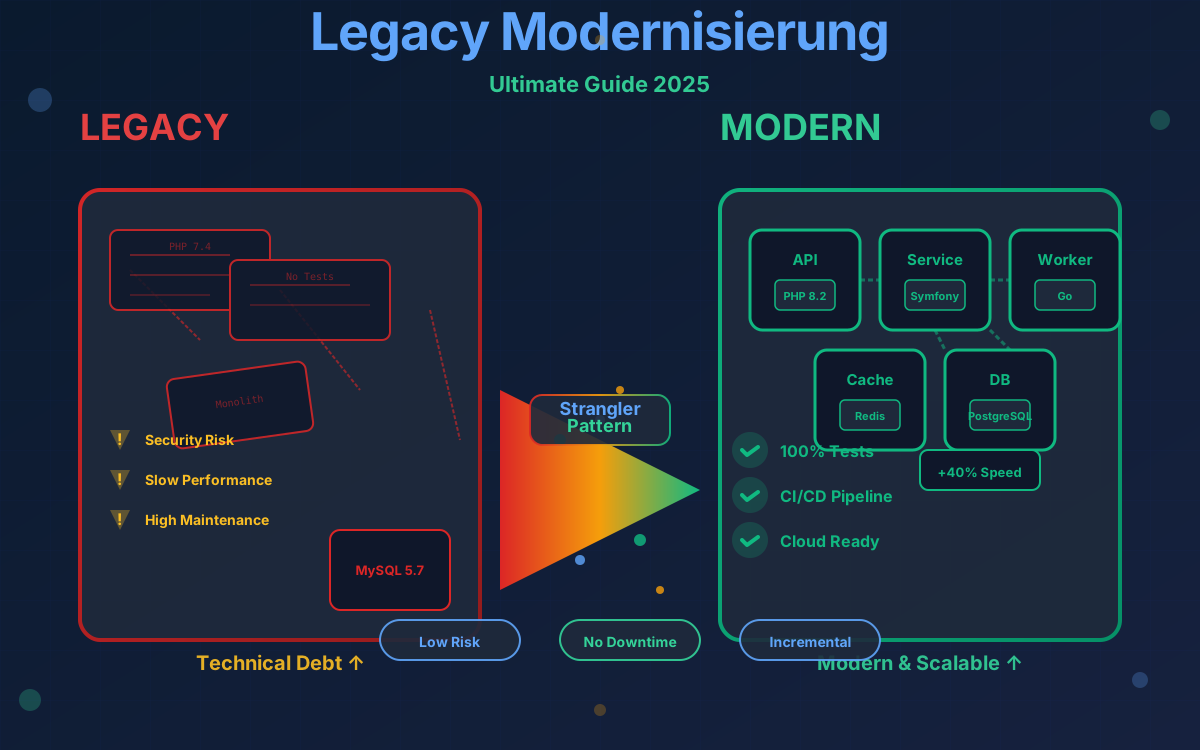
Legacy systems are like time bombs - they tick quietly until they explode. When your software is older than your developers, every change becomes a risk. This guide shows you how to strategically modernize legacy systems - without business interruption.
1. What is Legacy Modernization?
A legacy system is software that still works but has become problematic for various reasons:
- Technical obsolescence: Outdated programming languages, frameworks, or dependencies
- Organizational issues: No developers available anymore, missing documentation
- Architectural debt: Monolithic structure, missing modularity, high coupling
- Business risks: Security vulnerabilities, performance issues, scaling limits
Legacy modernization is the strategic process of gradually improving such systems - without endangering ongoing business. It's not about "rebuilding everything" but about controlled evolution.
Important
Legacy modernization is not a one-time project but a continuous process. The key lies in the right strategy: Big Bang, Strangler Pattern, or Incremental Refactoring - depending on the situation.
Why is Modernization Important?
The costs of not modernizing are often higher than the costs of modernization itself:
- Technical debt accumulates: What's a "quick fix" today costs double the development time tomorrow
- Security risks: Outdated frameworks have known vulnerabilities that are no longer patched
- Recruiting problems: Good developers don't want to work with outdated tech stacks
- Business limitations: New features are impossible or extremely expensive
- Cloud migration blocked: Legacy systems can't simply be migrated to the cloud
2. Recognizing Legacy Systems: Signs of Technical Debt
Technical Signs
Outdated PHP Versions
PHP 7.x has been End-of-Life since 2022. PHP 8.0 has been unsupported since 2023. If your system still runs on PHP 7.4 or older:
- No more security patches available
- Performance improvements from PHP 8.1+ are not utilized
- New libraries are not compatible
- Recruiting becomes harder (developers want modern PHP versions)
Critical
PHP 7.4 and older have known security vulnerabilities that are no longer patched. An upgrade to PHP 8.2+ should have highest priority.
End-of-Life Frameworks
- Symfony 3.x: End-of-Life since 2021 (current: Symfony 6.x/7.x)
- Laravel 5.x: End-of-Life since 2022 (current: Laravel 11.x)
- Shopware 5: End-of-Life since 2023 (current: Shopware 6)
Missing Tests
According to Michael Feathers' definition: Code without tests is legacy code. Period.
Typical symptoms:
- Test coverage under 20%
- Test suite doesn't pass anymore
- Tests were commented out "because they were annoying"
- Every change is a risk (no regression tests)
3. Modernization Strategies
Strategy 1: Strangler Fig Pattern
The Strangler Fig Pattern is the safest modernization strategy. Like a strangler fig that gradually grows around a host tree, the new system gradually replaces the old one:
- Identify boundaries: Which parts of the system can be isolated?
- Build parallel: New components are built alongside the old system
- Redirect traffic: Traffic is gradually redirected to new components
- Decommission: Old parts are shut down when no longer needed
Risk Minimization
The Strangler Pattern minimizes risk because the old system remains functional throughout. If something goes wrong with the new component, you can simply redirect back.
Strategy 2: Incremental Refactoring
For systems where the Strangler Pattern is too complex, incremental refactoring is a good alternative:
- Boy Scout Rule: Leave the code cleaner than you found it
- Opportunistic Refactoring: Refactor when you're already changing something
- Test-first: Write tests before refactoring
Strategy 3: Big Bang (Rewrite)
A complete rewrite is the riskiest strategy and should only be used as a last resort:
Warning
Rewrites fail in 70% of cases. The main reasons: underestimated complexity, missing business logic, parallel development in old system, budget overruns.
Consider rewrite only if:
- The system is so complex that gradual modernization is impossible
- Business requirements have fundamentally changed
- The technical platform is completely deprecated
4. The Modernization Process
Phase 1: Analysis & Planning (2-4 weeks)
- Code audit: Identify technical debt hotspots
- Dependency analysis: Which libraries are outdated?
- Business logic documentation: What does the code actually do?
- Migration plan creation: Priorities, timeline, milestones
Phase 2: Proof of Concept (2-4 weeks)
- Migrate a small feature to validate the approach
- Validate technology stack
- Team training on new technologies
Phase 3: Incremental Migration (3-12 months)
- Feature by feature migration
- Ensure parallel operation
- Write tests for every migrated component
- Set up monitoring
Phase 4: Cutover & Optimization (1-2 months)
- Final migration
- Performance optimization
- Update documentation
- Decommission old system
5. AI as Modernization Accelerator
In the AI age of 2025, artificial intelligence can significantly accelerate legacy modernization:
- Code understanding: AI can explain complex legacy code in natural language
- Test generation: AI can derive test cases from existing code
- Refactoring suggestions: AI can suggest improvements with explanations
- Documentation generation: AI can generate documentation from code
AI as Accelerator, Not Replacement
AI tools can accelerate modernization by up to 50%, but they cannot answer strategic questions: "Should I modernize PHP or migrate to Go?", "Are microservices really sensible here?" or "What risks am I overlooking?" A Fractional Tech Lead combines AI efficiency with human expertise.
6. Common Mistakes to Avoid
- Underestimating complexity: Legacy systems are more complex than they appear
- Missing documentation: Business logic is often only in the code
- Parallel development: New features in old system during migration
- Too aggressive timeline: Modernization takes time
- Skipping tests: Every migrated component needs tests
Conclusion
Legacy modernization is not a "nice-to-have" - it's a strategic necessity. The costs of not modernizing are often higher than the costs of modernization itself.
The key to success lies in:
- Choosing the right strategy (usually Strangler Pattern)
- Incremental approach instead of Big Bang
- Consistent testing of every change
- Team enablement through knowledge transfer
Free Legacy Assessment
Do you have a legacy system that needs modernization? I analyze your system and create a concrete migration plan.