API Development
Robust REST APIs, GraphQL interfaces, and seamless system integrations for your digital infrastructure
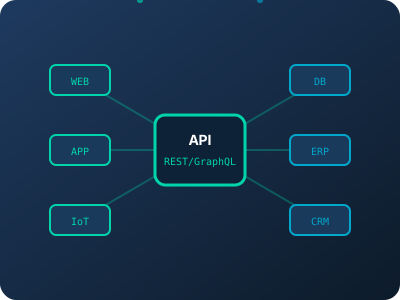
Why Professional APIs?
The foundation of modern software architecture
System Integration
Connect all your systems - ERP, CRM, Shop, and more - into a unified ecosystem.
Automation
Automate data synchronization, workflows, and business processes.
Scalability
Microservices architecture for flexible scaling of individual components.
Multi-Platform
One API for web, mobile apps, IoT devices, and partner integrations.
API Development Services
From concept to production-ready interface
REST API Development
Standard-compliant RESTful APIs following OpenAPI specification for maximum interoperability.
- OpenAPI/Swagger Documentation
- Versioning & Backward Compatibility
- Authentication (OAuth2, JWT)
- Rate Limiting & Throttling
GraphQL APIs
Flexible query language for complex data requirements with a single endpoint.
- Schema-First Design
- Subscriptions for Real-time
- N+1 Query Optimization
- Federation for Microservices
ERP & CRM Integration
Seamless connection to SAP, Salesforce, Microsoft Dynamics, and other enterprise systems.
- Bidirectional Synchronization
- Data Transformation
- Error Handling & Retry
- Monitoring & Alerting
Payment & E-Commerce APIs
Integration of payment providers, shipping APIs, and marketplace connections.
- Stripe, PayPal, Klarna
- DHL, UPS, DPD APIs
- Amazon, eBay Marketplace
- PCI-DSS Compliance
Integration Expertise
Experience with all common interfaces
E-Commerce
ERP / CRM
Payment
Logistics
Technology Stack
Modern tools for robust API development
Typical Use Cases
Where APIs create real value
Shop-ERP Sync
Automatic transfer of orders, inventory levels, and customer data.
Warehouse Automation
Connection to inventory management, automatic shipping labels and tracking.
Business Intelligence
Data aggregation from various sources for dashboards and reports.
CRM Integration
Customer history, lead scoring, and marketing automation.
Accounting
Automatic invoicing and accounting software export.
Partner Portals
B2B APIs for dealers, suppliers, and business partners.
API Development Process
Analysis & Design
Requirements analysis, API design following OpenAPI, and data modeling.
Prototyping
Mock server and contract-first development with automated tests.
Implementation
Development of endpoints, business logic, and database connection.
Security
Authentication, authorization, input validation, and penetration tests.
Documentation
Interactive API documentation with Swagger UI and code examples.
Deployment & Monitoring
CI/CD pipeline, logging, metrics, and alerting.
Frequently Asked Questions About API Development
REST or GraphQL - which is better?
Both have their strengths. REST is simpler, better cacheable, and ideal for CRUD operations. GraphQL is more flexible with complex data structures and reduces over-/underfetching. Often a combination makes sense.
How is API security ensured?
Through OAuth2/JWT authentication, HTTPS, input validation, rate limiting, CORS policies, and regular security audits. For sensitive data, additional encryption and audit logs.
Can an existing API be extended?
Yes, existing APIs can be extended with versioning without breaking existing integrations. Through API versioning (v1, v2), old clients remain functional.
How is the API documented?
With OpenAPI (Swagger) specification and automatically generated, interactive documentation. Developers can test APIs directly in the browser. Additionally, code examples in various languages.
Start Your API Project?
Let's intelligently connect your systems together.